The Scene in the Temple Treasury
How a nameless woman’s two small coins exposed the heart of true worship
The Scene in the Temple Treasury
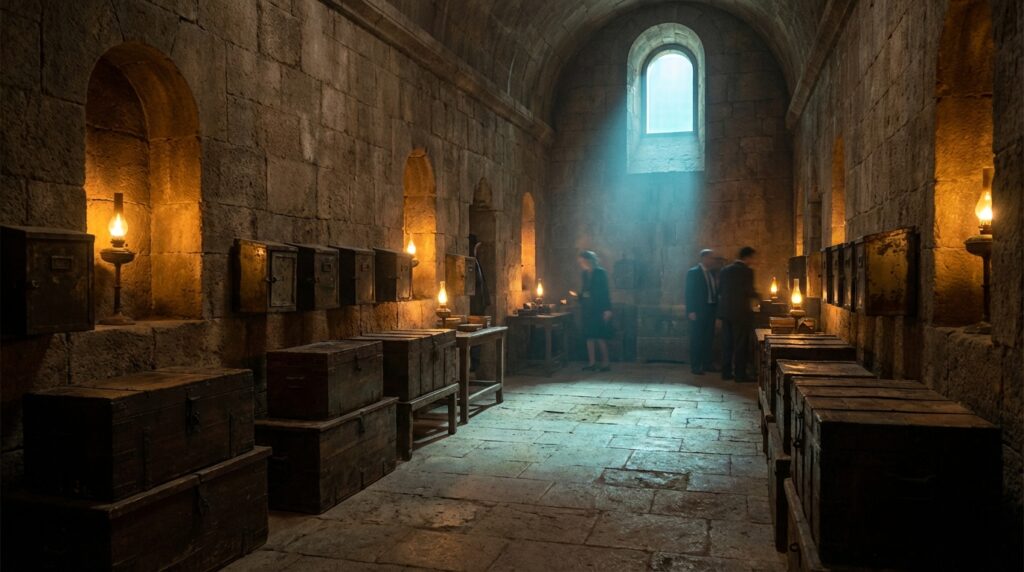
The setting is the Court of Women in the Jerusalem temple, where thirteen trumpet-shaped collection boxes stood against the wall. It’s during Passover week, and the temple is crowded with pilgrims. Jesus has just finished a scathing critique of the scribes who “devour widows’ houses” while making long, showy prayers. The religious leaders love recognition, honor, the best seats — they perform their piety for an audience.
Then Jesus sits down opposite the treasury. He’s watching. Not the amounts being given, but the givers themselves. The wealthy come and deposit their gifts — substantial sums that clang loudly into the metal receptacles. Then a widow approaches. In that culture, widows were among the most vulnerable — no husband to provide, no social security system, often dependent on the charity of others or their own meager labor. She drops in two lepta, the smallest copper coins in circulation.
Mark tells us Jesus called his disciples over specifically to make sure they saw this. In a day full of confrontations with religious authorities, debates about taxes and resurrection, this moment — this nameless woman’s gift — is what Jesus wants his followers to remember.
Free Advent reading · December 1–25
25 Names of Christ
One name a day in your inbox: the verse it comes from, a short reflection, a one-line prayer. It ends on Christmas morning.
One email a day, December 1–25. Unsubscribe anytime.
What Made Her Gift Greater?
Jesus’ mathematics here defy our understanding of value. The rich gave more in actual currency. Their gifts funded temple operations, supported priests, maintained the building. By any practical measure, their contributions mattered more. So what is Jesus seeing that makes this widow’s offering surpass all of theirs?
The Greek word Mark uses is “lepton,” meaning “thin one” — the smallest, lightest coin. Two lepta equaled one quadrans, a Roman coin worth 1/64 of a denarius (a day’s wage). This widow gave roughly 15 minutes of labor’s worth. But Mark’s careful note that she gave “all she had to live on” (Greek: holon ton bion autēs — literally “her whole life”) reveals Jesus’ point isn’t about the amount, but about the totality of the gift.
The answer lies in the phrase “out of their abundance” versus “out of her poverty.” The wealthy gave from their surplus — they had plenty left over. Their lifestyle wouldn’t change. Their security remained intact. They gave what they could spare without discomfort. She gave what she couldn’t spare. She gave everything.
But here’s what’s even more striking: Jesus doesn’t commend her for giving “a lot considering her circumstances” or “more than expected for someone poor.” He says she gave MORE than all of them — not proportionally more, but actually more. Because she gave her whole life. She held nothing back. She placed her complete trust in God’s provision when she had every earthly reason not to.
The Scandal of Total Trust
We sanitize this story. We turn it into a lesson about sacrificial giving during stewardship campaigns. But stop and consider what this widow actually did. She had two coins. She could have kept one and given one — that would still be sacrificial, still generous. She would have had something left for tomorrow’s bread. Instead, she gave both. She walked away with nothing. No backup plan. No safety net. No rational justification.
From a practical standpoint, her action makes no sense. The temple didn’t need her two lepta. The wealthy were covering the bills. Her gift wouldn’t change anything materially. And she desperately needed that money. This is a woman the system had already failed — likely the very kind of widow whose house the scribes had “devoured.” The religious establishment had taken from her; now she’s giving back to it.
Unless… unless her gift wasn’t really to the temple at all. Unless it was to God himself. Unless she understood something about worship that the wealthy givers didn’t: that God doesn’t want what we can afford to give. He wants what we can’t afford to withhold. He’s after our hearts, and the heart is most clearly revealed not in our abundance but in our scarcity, not in our comfort but in our desperation.
This widow’s two coins were her declaration: “God, I trust you more than I trust these coins. I trust you more than I trust my own planning, my own provision, my own survival instincts. I give you everything because you are everything.”
When God Asks for Everything
Here’s what makes this passage so uncomfortable for us: Jesus doesn’t rebuke her. He doesn’t run after her and say, “Wait, that’s too much — keep one coin, be reasonable!” He commends her. He holds her up as the model. Which means God really does ask us to trust him with everything, even when everything is all we have.
The Abundance Trap
When we have plenty, we think we’re trusting God while actually trusting our bank accounts, our insurance, our retirement plans. We give from our surplus and call it faithfulness, but our security rests in what we keep, not in what we give.
The Scarcity Invitation
When we have little, we’re forced to confront the question: Is God really enough? The widow’s gift answers yes. Not theoretically, not theologically, but practically. She bet her life on God’s faithfulness, and Jesus says she won that bet.
The Freedom of Nothing Left
There’s a strange freedom in having nothing left to protect. The widow couldn’t worry about losing what she’d already given away. She was free to rest entirely in God’s character, God’s promises, God’s provision. Her poverty became the doorway to a kind of trust the wealthy couldn’t access.
This isn’t about money alone. God asks for everything — our plans, our relationships, our reputations, our futures, our very selves. He asks us to hold nothing back, to give him our whole lives the way this widow gave her whole livelihood. And he asks this not because he’s a tyrant demanding tribute, but because he’s a Father who knows that we only find true life when we stop trying to manufacture our own security and rest completely in his.
The widow’s mite shows us what discipleship looks like when it costs us everything we have. It’s not glamorous. Nobody sees it but Jesus. It doesn’t make sense to the world. It might not even make sense to us. But it’s the kind of faith that Jesus notices, commends, and treasures. Because it’s the kind of faith that mirrors his own — the Son of God who gave not two coins but his own life, not holding back anything, trusting completely in the Father’s plan even unto death.
The Invitation to Trust
So what does this widow’s example call us to? Not to reckless financial irresponsibility or false spirituality that refuses to plan wisely. But to an honest examination of where our real trust lies. To ask ourselves: What am I holding back from God? What am I protecting, preserving, keeping in reserve “just in case”? Where am I giving from my abundance while keeping my security intact?
Perhaps it’s money, yes. Perhaps God is calling you to give in a way that actually requires faith, that makes you depend on him rather than your own resources. But perhaps it’s something else entirely. A relationship you won’t surrender. A dream you won’t lay down. A plan you won’t release. A hurt you won’t forgive. A control you won’t relinquish. An identity you won’t let die.
The widow’s story tells us that God sees. He sees past the amounts to the hearts. He sees past the appearance of generosity to the reality of trust. And he honors not the size of the gift but the totality of the surrender. He’s looking for people who will bet everything on his faithfulness, who will give their whole lives — not their surplus, not their leftovers, not their comfortable excess, but everything — and discover that he is more than enough.
That’s the scandalous, beautiful, terrifying invitation of the widow’s mite. To stop calculating. To stop protecting. To stop holding back. To give God everything and find that in losing your life, you finally, truly live.
Wear Your Faith
Let your daily walk be a testimony to God’s faithfulness. Explore our collection of faith-inspired apparel and products designed to encourage you and start conversations about the hope we have in Christ.
Shop NowFrom the shop
Scripture to wear and give, printed to order.
-
✝2 Corinthians 5:21

Substitution | 2 Corinthians 5:21 Soccer Tee
Price range: $30.00 through $36.00 Select options This product has multiple variants. The options may be chosen on the product page -
✝2 Corinthians 5:17
Made New Y2K Butterfly Baby Tee | 2 Corinthians 5:17
$34.00 Select options This product has multiple variants. The options may be chosen on the product page -
✝Isaiah 9:6
25 Names of Christ | Printable Advent Poster and Scripture Cards
$6.99 Add to cart


Keep reading
- Youth Group Shirt Ideas: Christian Tees Teens Will Actually WearChristian Living
- Christian Gifts for Dad: 8 Faith-Based Gifts He Will UseChristian Living
- Who You Are in Christ: Your Identity, and the Shirts That Say It Out LoudChristian Living
- Bible Verse T-Shirts: How to Wear Scripture That Actually Means SomethingBible Study
- The Midday Meeting That Changed EverythingFaith & Encouragement
- The Night Heaven and Earth Held Their BreathFaith & Encouragement
More in: Faith & Encouragement · All articles