The Midday Meeting That Changed Everything
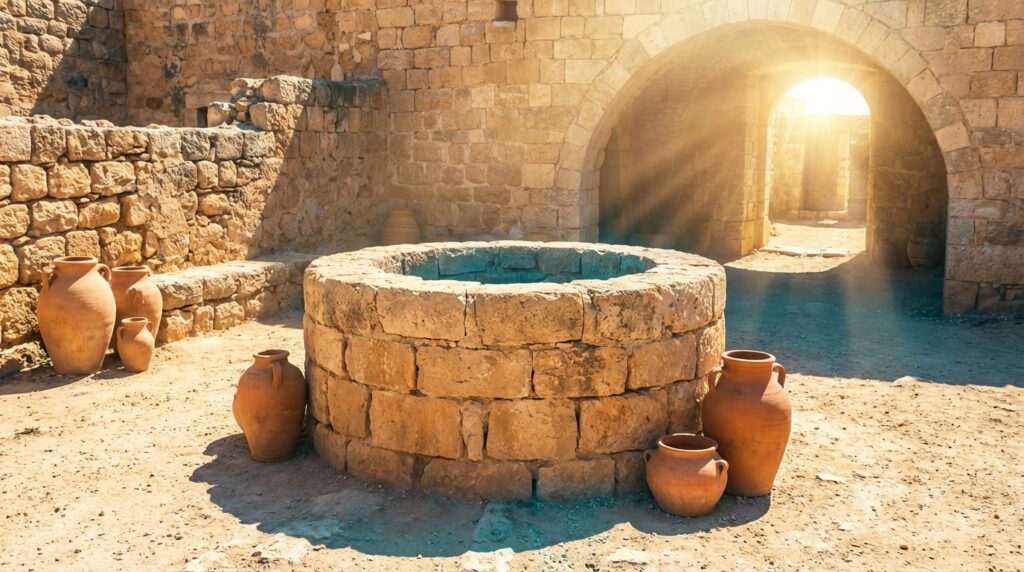
How a midday encounter at a well reveals the thirst we all carry—and the only One who can truly satisfy it
The Midday Meeting That Changed Everything
John chapter 4 opens with Jesus doing something scandalous: traveling through Samaria. Most Jewish teachers would take the long route around to avoid Samaritan territory—centuries of ethnic and religious hostility had created a wall of contempt between these communities. But John tells us Jesus “had to go through Samaria.” This wasn’t geographical necessity. This was divine appointment.
Tired from the journey, Jesus sits by Jacob’s well around noon—the sixth hour, when the sun beats down mercilessly and respectable people are sheltered indoors. That’s when she comes. A Samaritan woman. Alone. At the hottest part of the day. The timing itself speaks volumes about a life lived in the margins.
Notice what Jesus does here. He doesn’t lead with condemnation or a sermon. He starts with a simple request that breaks every social boundary of His time: He asks her for help. A Jewish rabbi speaking to a Samaritan. A man addressing a woman alone. Someone ritually clean engaging someone considered unclean. In one sentence, Jesus demolishes the dividing walls she’s spent her whole life navigating.
Free Advent reading · December 1–25
25 Names of Christ
One name a day in your inbox: the verse it comes from, a short reflection, a one-line prayer. It ends on Christmas morning.
One email a day, December 1–25. Unsubscribe anytime.
Living Water: The Depth Behind the Metaphor
The woman’s response reveals her confusion—and her defense mechanisms. She points out the obvious barriers: ethnicity, gender, social protocol. But Jesus redirects the conversation to something deeper. He speaks of “living water,” a phrase rich with meaning that would have resonated with anyone familiar with the Hebrew Scriptures.
The term “living water” in Hebrew (mayim chayim) refers to flowing, fresh water from a spring or stream, as opposed to stagnant water in a cistern. The prophets used this imagery powerfully. Jeremiah 2:13 records God’s indictment: “My people have committed two sins: They have forsaken me, the spring of living water, and have dug their own cisterns, broken cisterns that cannot hold water.” Jesus isn’t just offering better water—He’s claiming to be the fulfillment of what the prophets promised, the very source of life itself.
The woman takes Him literally at first—understandably. She’s thinking about the physical burden of daily trips to the well, the aching arms, the heavy jars. But Jesus is addressing a different kind of thirst altogether.
Then comes the moment that changes everything. Jesus says, “Go, call your husband and come back.” She answers honestly: “I have no husband.” And Jesus responds with words that must have stopped her heart: “You are right when you say you have no husband. The fact is, you have had five husbands, and the man you now have is not your husband. What you have said is quite true.”
This isn’t condemnation—it’s revelation. Jesus sees her. Fully. The thing she’s been hiding, the reason she comes to the well at noon, the source of her shame and isolation—He knows it all. And He’s still sitting there, still talking to her, still offering her living water.
When Being Seen Becomes Liberation
Here’s the stunning reversal: the very exposure the woman feared becomes the pathway to freedom. She doesn’t run away. Instead, she shifts the conversation to theology—a move that reveals she’s more spiritually hungry than she’s perhaps ever admitted. She asks about the proper place of worship, about Messiah. And Jesus makes a declaration He rarely makes so directly: “I, the one speaking to you—I am he.”
Notice what she leaves behind: her water jar. The very thing she came for. Because she’s found something—Someone—who addresses the thirst beneath her thirst. And notice what she does next: she goes back to the very community she’d been avoiding. She becomes the first evangelist, inviting others to “come and see” the one who saw her and loved her anyway.
This is the pattern of grace. Jesus meets us in our isolation, sees what we’ve been hiding, and instead of condemning us, offers us the very thing that will finally satisfy. Not a program, not a formula, not even a behavior modification plan—but Himself. Living water that becomes a spring within us, transforming us from the inside out.
The Thirst We All Carry
The woman at the well represents every person who’s ever tried to fill a God-sized void with human solutions. Five husbands—we could translate that into five careers, five moves, five relationships, five versions of ourselves we’ve tried on hoping one would finally fit. We come to our own wells at our own noon hours, carrying jars we hope will hold what we need, living in patterns that keep us functional but never truly satisfied.
She Was Avoiding Community
Her isolation was self-protective. When you’ve been wounded by judgment, you learn to time your life around avoiding it. But isolation itself becomes another form of thirst—we were created for connection, for belonging, for being known.
She Was Searching for Significance
Five husbands suggest a pattern of seeking validation, identity, and worth through relationships. Each one promising fulfillment, each one eventually revealing its limitations. We do the same with achievement, approval, appearance, or any number of counterfeit waters.
She Was Hiding Her Shame
The noon hour wasn’t random. It was calculated. It was the price of privacy. But shame always isolates, and isolation always amplifies shame. Jesus breaks this cycle not by exposing her to condemn, but by seeing her to liberate.
What Jesus offers her—and us—is not a better version of what we’ve been trying. It’s something completely different. It’s not self-improvement; it’s transformation. Not behavior modification; it’s a new source of life itself. The living water He speaks of is the Holy Spirit, the very presence of God taking up residence within us, creating an artesian well that flows from the inside out.
This means we stop coming to external sources hoping they’ll fill internal voids. We stop performing for approval because we’ve already been seen and loved. We stop hiding because we’ve discovered that being fully known by God is the safest place we could ever be. We stop managing our image because we’ve found our identity in the One who made us.
Jesus tells her that true worship isn’t about location—mountain or temple, Samaria or Jerusalem. It’s about spirit and truth. It’s about bringing our real selves to the real God and finding that His grace is sufficient, His love is unfailing, and His water is living.
Come and See
The woman’s transformation is evidenced not just by what she believed, but by what she did. She went back. Back to the community. Back to the people who knew her story. But now she went with a different story to tell—not about her shame, but about the One who saw it all and offered her life anyway.
“Come, see a man who told me everything I ever did.” That’s the gospel in miniature. Jesus sees everything—and still offers everything. He knows your noon hours, your coping mechanisms, your broken cisterns and failed attempts to quench your thirst. And He’s still sitting at the well, waiting to offer you living water.
The invitation is the same today as it was then. Stop drawing from wells that can never satisfy. Stop hiding in your noon hours. Stop trying to manage your thirst with temporary solutions. Come to the One who is the source of life itself. Drink deeply. And discover that when Jesus satisfies your deepest thirst, you become a fountain for others—carrying hope back to the very places you once avoided.
Carry This Truth With You
Let the story of living water remind you daily that you are seen, known, and loved by the God who satisfies every thirst. Explore our faith-inspired apparel and products designed to help you share the hope found in Christ.
Shop NowFrom the shop
Scripture to wear and give, printed to order.
-
✝1 John 1:9

Note to God | 1 John 1:9 Tee
Price range: $34.00 through $36.00 Select options This product has multiple variants. The options may be chosen on the product page -
✝John 19:30
It Is Finished | John 19:30 Soccer Tee
Price range: $34.00 through $36.00 Select options This product has multiple variants. The options may be chosen on the product page -
✝1 John 5:11
Get in the Loop | 1 John 5:11 Memento Mori Tee
Price range: $38.00 through $42.00 Select options This product has multiple variants. The options may be chosen on the product page



Keep reading
- Youth Group Shirt Ideas: Christian Tees Teens Will Actually WearChristian Living
- Christian Gifts for Dad: 8 Faith-Based Gifts He Will UseChristian Living
- Who You Are in Christ: Your Identity, and the Shirts That Say It Out LoudChristian Living
- Bible Verse T-Shirts: How to Wear Scripture That Actually Means SomethingBible Study
- When God Seems Silent: What Habakkuk’s Watchtower Teaches Us About Waiting for AnswersBible Study
- The Test That Redefined FaithFaith & Encouragement
More in: Faith & Encouragement · All articles