The Night Heaven and Earth Held Their Breath

When the will of God feels unbearable, remember the garden
The Night Heaven and Earth Held Their Breath
It’s Thursday night, just hours before the crucifixion. Jesus has finished the Passover meal with His disciples and knows exactly what’s coming — betrayal, arrest, torture, abandonment, and a death that will bear the full weight of humanity’s sin. He leads His closest friends to an olive grove on the Mount of Olives, a place He’s retreated to many times before. But tonight is different. Tonight, the weight of the world’s redemption presses down on His shoulders.
Luke, a physician by trade, is the only Gospel writer who records the detail of Jesus sweating blood — a rare medical condition called hematidrosis that occurs under extreme emotional and physical stress. This isn’t a calm, composed prayer meeting. This is agony. The Greek word Luke uses is “agonia” — the root of our word “agony.” Jesus is in torment, fully aware of what the “cup” contains: not just physical death, but spiritual separation from the Father as He becomes sin for us.
Free Advent reading · December 1–25
25 Names of Christ
One name a day in your inbox: the verse it comes from, a short reflection, a one-line prayer. It ends on Christmas morning.
One email a day, December 1–25. Unsubscribe anytime.
The Honest Prayer That Changed Everything
Here’s what strikes me most about Gethsemane: Jesus doesn’t hide His true feelings from the Father. He doesn’t put on a spiritual mask and pretend to be okay with the crucifixion. He asks — pleads — for another way. “If you are willing, take this cup from me.” This is raw, honest prayer. The kind we’re often afraid to pray because we think it shows a lack of faith.
The “cup” Jesus refers to has deep Old Testament roots. In Scripture, the cup often symbolizes God’s wrath against sin (Psalm 75:8, Isaiah 51:17). Jesus isn’t just facing physical death — He’s about to drink the full measure of God’s judgment that we deserve. No wonder He asks if there’s another way. The weight He’s carrying is incomprehensible.
But notice the progression of Jesus’s prayer. He starts with His human desire — “take this cup from me” — and then immediately surrenders to the Father’s will — “yet not my will, but yours be done.” This is the anatomy of biblical surrender. It’s not denying your feelings or pretending you don’t struggle with God’s plan. It’s bringing your whole heart, fears and all, before the Father and then choosing His way over yours.
Jesus was heard. Not because the Father changed the plan, but because the Father met Him in His anguish. An angel came to strengthen Him. The Father didn’t remove the cup, but He gave Jesus the grace to drink it. And that changes everything about how we approach our own Gethsemane moments.
When Your Will and God’s Will Collide
We face our own Gethsemane moments — times when what God is calling us to feels impossible. Maybe it’s forgiving someone who destroyed you. Maybe it’s staying in a difficult marriage when every impulse screams to leave. Maybe it’s accepting a diagnosis, releasing a dream, or walking away from something that was once good but is no longer God’s will. Maybe it’s simply trusting God with a future you can’t control.
Here’s what Gethsemane teaches us: surrender isn’t the absence of struggle. It’s not arriving at a place where God’s will feels easy or desirable. Jesus’s experience proves that we can be in perfect alignment with God’s will and still feel the crushing weight of it. We can be walking in obedience and still sweat blood over what it costs.
Honest Wrestling
Jesus shows us that we can bring our real emotions to God — our fear, our desire for escape, our “I don’t want to do this.” He doesn’t want our fake composure. He wants our hearts.
Submitted Choosing
After the honesty comes the choice: “yet not my will, but yours be done.” Surrender isn’t a feeling — it’s a decision we make even when our feelings haven’t caught up yet.
Strengthened Walking
God doesn’t always remove the hard thing, but He always provides strength for it. The same God who sent an angel to strengthen Jesus will meet you in your moment of weakness.
The Invitation to Garden Prayer
Gethsemane invites us into a deeper kind of prayer — the kind that doesn’t skip over the hard parts but walks straight through them with God. It’s the prayer that says, “Father, I don’t want this. I’m terrified. I don’t see how I can do what You’re asking.” And then, in the same breath, “But I trust You more than I trust my fear. Your will, not mine.”
This kind of surrender doesn’t make the hard thing easy. Jesus still went to the cross. But it transforms how we carry it. We carry it not alone, not in bitter resentment, not in white-knuckled self-effort — but in communion with the Father who strengthens us, the Son who’s already walked this road before us, and the Spirit who prays for us when we don’t have words.
The beauty of Gethsemane is this: Jesus chose the cup so that when you face your cup — your unbearable loss, your impossible calling, your excruciating obedience — you never have to choose it alone. He’s been there. He knows. And He’s with you.
Whatever garden you’re in tonight, whatever cup you’re staring at, bring it all to the Father. Tell Him the truth. Wrestle honestly. And then, when you’re ready — even if you’re not ready — whisper the words that change everything: “Not my will, but Yours be done.” He will meet you there. He will strengthen you. And He will walk with you all the way through.
Wear Your Faith
Let your clothing tell the story of surrender and strength. Our faith-inspired apparel reminds you daily that God’s will, though sometimes costly, is always good. Explore designs that declare His faithfulness.
Shop NowFrom the shop
Scripture to wear and give, printed to order.
-
✝Hebrews 9:27

Final Whistle | Hebrews 9:27 Soccer Tee
Price range: $30.00 through $32.00 Select options This product has multiple variants. The options may be chosen on the product page -
✝Matthew 1:23
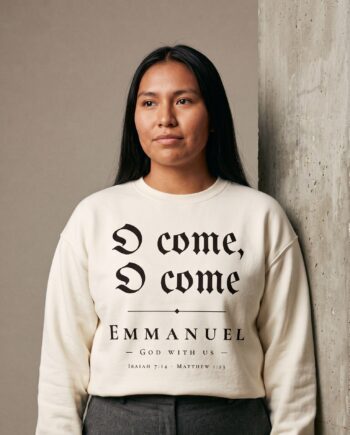
O Come, O Come, Emmanuel | Matthew 1:23 Christmas Tee & Crewneck
Price range: $34.00 through $56.00 Select options This product has multiple variants. The options may be chosen on the product page -
✝Matthew 6:11
Give Us This Day Our Daily Bread | Matthew 6:11 Tee & Sweatshirt
Price range: $34.00 through $72.00 Select options This product has multiple variants. The options may be chosen on the product page


Keep reading
- Youth Group Shirt Ideas: Christian Tees Teens Will Actually WearChristian Living
- Christian Gifts for Dad: 8 Faith-Based Gifts He Will UseChristian Living
- Who You Are in Christ: Your Identity, and the Shirts That Say It Out LoudChristian Living
- Bible Verse T-Shirts: How to Wear Scripture That Actually Means SomethingBible Study
- The Scene in the Temple TreasuryFaith & Encouragement
- The Scene: Alone on the WatersFaith & Encouragement
More in: Faith & Encouragement · All articles