Psalm 136 Bible Study: Gratitude as Remembering
Most Thanksgiving talk about gratitude is a list. Family, health, food on the table. Psalm 136 does something different. It gives thanks by telling the story, and the story includes the death of Egypt’s firstborn, an army drowned in the sea, and kings struck down. After each of those the same line comes back. This study walks through the psalm in order, takes the hard verses seriously, and ends with an exercise in which your group writes its own version. It can be taught in one long session or three short ones.
The passage in its context
Psalm 136 has no named author, and its date is debated. The psalm does not tell us when it was written or what occasion called for it, so this study will not guess. What we can see is its shape. It has 26 verses, and every one ends with the same Hebrew refrain, ki le’olam chasdo. The KJV renders it “for his mercy endureth for ever.” The World English Bible renders it “for his loving kindness endures forever.” Twenty-six verses, twenty-six refrains. No source I found shows that the number means anything in itself.
The refrain was not invented for this psalm. The same words appear when the ark is brought in (1 Chronicles 16:34), when the temple is dedicated (2 Chronicles 5:13; 7:3, 6), and when the returned exiles lay the temple foundation (Ezra 3:10–11). Psalm 107:1 and Psalm 118:1 open with the same formula. It was a standing phrase of Israel’s worship, used in moments of arrival and rebuilding.
Jewish tradition calls Psalm 136 Hallel HaGadol, the Great Hallel, to distinguish it from the Egyptian Hallel of Psalms 113 to 118. The Talmud (Pesachim 118a) records a disagreement over whether the Great Hallel is Psalm 136 alone, 135 and 136, or 134 to 136. The accepted view is Psalm 136 alone. It is recited toward the end of the Hallel at the Passover seder. In Eastern Orthodoxy, Psalms 135 and 136 together are the Polyeleos, sung at Orthros on feast days.
Many study Bibles also describe it as responsive: a leader sings the first line and the congregation answers with the refrain. That is an inference from the form. The psalm itself does not say who sang what, so hold it as a reasonable reading and not a certainty.
Free Advent reading · December 1–25
25 Names of Christ
One name a day in your inbox: the verse it comes from, a short reflection, a one-line prayer. It ends on Christmas morning.
One email a day, December 1–25. Unsubscribe anytime.
Observations that stay in the text
The call (vv. 1–3). Three verses ask for thanks, each naming God differently: good, God of gods, Lord of lords. Verse 1 in the KJV reads:
“O give thanks unto the LORD; for he is good: for his mercy endureth for ever.”
The reason for thanks is given before any event is named. He is good, and his love lasts.
Creation (vv. 4–9). The heavens, the earth over the waters, the sun, the moon and the stars. Notice that creation comes first and is counted as an act of steadfast love, before any rescue is needed.
Exodus (vv. 10–15). This is where the psalm refuses to be sentimental. Verse 10 in the KJV:
“To him that smote Egypt in their firstborn: for his mercy endureth for ever.”
The refrain follows the striking of the firstborn. It follows the parting of the sea and the overthrow of Pharaoh and his army. Exodus 12 to 14 tells the same events at length.
Wilderness and land (vv. 16–22). The wilderness journey, then the striking of great kings, Sihon of the Amorites and Og of Bashan, and the giving of their land as a heritage to Israel. Psalm 135:8 to 12 recites nearly the same sequence, and the two make a useful side-by-side reading. Compare Numbers 21 and Deuteronomy 2 and 3 for the narrative behind it.
Us (vv. 23–26). The pronoun changes. Verse 23 in the KJV:
“Who remembered us in our low estate: for his mercy endureth for ever.”
The psalm does not say which low estate. It could fit several of Israel’s worst seasons, and the text leaves it open. It then widens to God who gives food to all flesh, and closes with a call to thank the God of heaven.
One more observation. Nearly every line is about something God did, and almost none is about something the singer received. The psalm is a sequence of events, not an inventory of gifts. Compare Psalm 78, which also retells the story but spends its length on Israel’s unfaithfulness. Psalm 136 tells the same history entirely from the side of what God did.
What “steadfast love” means
The Hebrew word is chesed, and no English word carries all of it. The KJV says “mercy,” the WEB “loving kindness,” and many modern versions “steadfast love.” Underneath all of them is covenant faithfulness: loyal, committed love that keeps its word. It is less a feeling than a promise kept over time.
That matters for how the refrain works. The psalm does not claim that every moment felt kind. It claims that God stayed faithful through the plagues, the sea, the wilderness and the low places. The refrain is not a promise that believers will avoid suffering. The psalm sits beside the exile and the low estate, and it says the love outlasted them.
What it meant then
For a worshipping community, reciting this history out loud was a way of placing themselves inside it. Everyone who answered “his love endures forever” was agreeing that the sea, the wilderness and the land were part of their own story. At Passover the same logic is explicit: the retelling is meant to make the exodus present to the people at the table.
The turn to “us” in verse 23 completes that. The history is not a museum exhibit. It runs straight into the present, and the present congregation is the latest line in the litany.
The hard verses, honestly
Verses 10, 15 and 17 to 20 are difficult, and a study that skips them has missed the point. A psalm of thanks gives thanks after the death of children and the death of kings.
Christians read this in several ways, and the reading is contested. Some see the judgment on Egypt and the defeated kings as God acting against oppression within the story of Israel’s rescue, so that the rescue cannot be told without it. Some read the conquest accounts in light of Christ, as a partial and early stage in a revelation that later changes how God’s people are called to treat enemies. Others are troubled by the text and decline to resolve it, letting it stand as part of Scripture that still asks questions of us. A leader should lay these out and not choose one as settled.
Two limits are safe. The psalm does not give anyone a template for violence today. And it does not sanitize: the writer does not soften verse 10 before adding the refrain. Whatever the refrain means here, it means it over the whole story, not only the pleasant parts.
If your group wants to show that remembering also holds grief, read Psalm 137 afterward. It is a lament from Babylon that follows the liturgy of 136 immediately. Be warned that verses 8 and 9 are very hard to read, and it is fine to stop short of them.
What it asks now
Deuteronomy 8:2 and 11 to 18 gives the theology behind the psalm’s method. Moses tells Israel to remember the whole wilderness road, and he warns that in prosperity they will be tempted to say their own strength produced their wealth. Deuteronomy 6:10 to 12 makes the same warning about a land of plenty. In both, the danger is forgetting, and the remedy is telling the story again.
That is why Psalm 136 is a better Thanksgiving text than a blessings list. A list can be recited while forgetting. A story with its hard chapters cannot. It forces the question of how we got here and who carried us, and it leaves gratitude resting on something that held through the bad years.
Write your own litany
This works for a small group, a family, or a church committee. Allow forty-five minutes.
- Choose a refrain. The psalm’s own line works, or a short sentence your group agrees on. Keep it to one breath.
- Start with the call. Two or three lines that name who God is, as verses 1 to 3 do.
- Tell the history in plain events. Use real moments from your church, family or town: a founding, a move, a building, a death, a split, a recovery. Name what happened, not what it taught you.
- Include a hard one. Add at least one event that still hurts, and say it plainly. Then let the refrain follow it, as the psalm does after verse 10 and verse 23. Do not explain the refrain away.
- Close with “us.” End in the present, with where the group is now.
- Read it aloud. One person reads each line and everyone answers with the refrain.
A template for one line: “[God’s action, stated as an event], for his steadfast love endures forever.” The group fills in the first half.
A Thanksgiving table version
Before the meal, give each person one slip of paper and ask them to write a single event from the family’s history, one line, past tense. Include at least one that was hard. A reader goes around the table. After each event, everyone says the refrain together. End with a short prayer thanking God for faithfulness through all of it. This is a seasonal use only. The psalm did not originate with any holiday, and it works on any day the family wants to remember.
Leader’s notes
Read the whole psalm aloud once at the start, with the group answering the refrain, before any discussion. If someone raises the objection that the repetition is the “vain repetition” Jesus warned against, point out that the refrain is the content, not a substitute for it: each line names a different act, and the repetition ties them together. If the violence dominates the conversation, give it the time it needs, and then return to verse 23. Plan the litany exercise for the last third of the time, and leave room for silence after the hard events are read.
Questions for discussion
- The psalm gives thanks by retelling events and not by listing gifts. How does that change what gratitude feels like, compared with how you usually practice it?
- Why might the writer have put creation before any rescue? What does it say about where thanks begins?
- The refrain follows verse 10 and verse 15 without comment. What do you do with that, and what do you think the psalm is claiming about God’s steadfast love?
- Which of the readings of the conquest verses described above comes closest to your own, and what troubles you about it?
- The pronoun shifts to “us” in verse 23. Where in your own family or church history would you place a “low estate,” and what would it mean to say the refrain after it?
- Deuteronomy 8 warns that prosperity makes people forget. What practices in your life keep memory alive, and which ones quietly erode it?
- As you write your litany, which event is hardest to include, and what would it cost the group to leave it out?
From the shop
Scripture to wear and give, printed to order.
-
✝Psalm 46:5

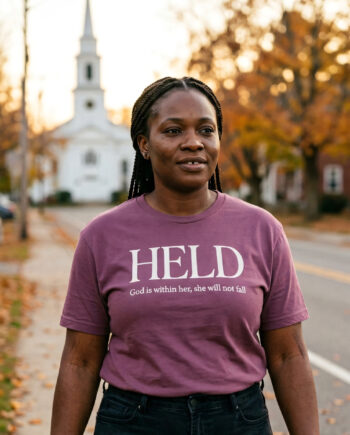
Held | Psalm 46:5 Tee for Women
Price range: $34.00 through $38.00 Select options This product has multiple variants. The options may be chosen on the product page -
✝Psalm 46:10
Coffee and Quiet Time Retro Hoodie | Psalm 46:10
Price range: $49.00 through $51.00 Select options This product has multiple variants. The options may be chosen on the product page -
✝Psalm 95:6
O Come Let Us Adore Him | Psalm 95:6 Christmas Crewneck & Tee
Price range: $34.00 through $56.00 Select options This product has multiple variants. The options may be chosen on the product page


Keep reading
- The Bereans and Acts 17:11: Receive the Word, Then Test ItBible Study
- Know That the LORD Is God: A Four-Week Psalm 100 StudyBible Study
- Four Weeks to Belonging: A Study for Groups Just Getting StartedBible Study
- You Belong Here: A Study Through Romans 8 on Adoption in ChristBible Study
- Now Thank We All Our God: The Hymn Story Behind RinkartChristian Living
More in: Bible Study · All articles