Now Thank We All Our God: The Hymn Story Behind Rinkart
“Now Thank We All Our God” began as a short table prayer written by a Lutheran pastor in a German town that war had stuffed with refugees and then emptied with plague. Martin Rinkart wrote the German original, “Nun danket alle Gott,” around 1636. The exact date is debated, and so are several of the stories told about it. This post sorts what the sources support from what has been added since, then walks through the three stanzas and ends with a way to use the hymn at your own table.
A hymn that began as a table prayer
The text is usually dated to about 1636 and first appeared in Rinkart’s Jesu Hertz-Büchlein, as a short prayer to be said at meals. That is a plainer origin than the one most people hear. It was not composed for a cathedral or a victory service. It was meant for a household sitting down to eat.
Catherine Winkworth’s English translation was first printed in Lyra Germanica, Second Series, in London in 1858. Sources give her birth year as 1827 or 1829, so I will leave that alone. Her translation is in the public domain, which is why it is quoted below.
Free Advent reading · December 1–25
25 Names of Christ
One name a day in your inbox: the verse it comes from, a short reflection, a one-line prayer. It ends on Christmas morning.
One email a day, December 1–25. Unsubscribe anytime.
Eilenburg, 1618 to 1648: who Martin Rinkart was
Rinkart was born in 1586 and died in 1649. He served as a Lutheran pastor in Eilenburg, in Saxony, through the Thirty Years’ War. The town was walled, which made it a refuge, and it filled with people running from the fighting. Sources say armies overran it three times. Famine came, and then plague.
In 1637 Rinkart was reportedly the only pastor left alive in Eilenburg. The other clergy had died or gone. He is said to have conducted more than 4,000 funerals, and older accounts give about 4,480, among them his wife’s. Some tellings add that he buried as many as 50 people in a single day. Treat all of these numbers as reported and approximate. What the sources agree on is the shape of it: one pastor, a town dying around him, and the same words of committal said over and over.
I will not say more about his wife’s death than the sources do. They record that he buried her. They do not give us her last days or his words, and inventing them would be a kind of lie.
What we can and cannot say about the legends
Three stories travel with this hymn, and they deserve different levels of trust.
- The peace celebration. Many pages say Rinkart wrote the hymn for the end of the war. One hymnal companion argues this impression came from a coincidence: the Elector of Saxony chose Sirach verses for the thanksgiving services, and the hymn is built on those same verses. The better-supported account is the table prayer of about 1636 or earlier. The hymn was widely sung by the Peace of Westphalia in 1648, so it was certainly present at the end of the war. It just was not written for it.
- The Swedish ransom. A popular story has Rinkart pleading with an occupying commander for the town’s relief. Versions vary in the details, and I found no primary source for it. Hold it as tradition.
- Leuthen, 1757. The tale that a Prussian army sang the hymn after that battle is questioned by historians as a later invention. I would leave it out.
None of this makes the hymn smaller. A table prayer written by a man who was burying his neighbours is a stranger and more honest thing than a victory song.
Stanza one: “Now thank we all our God”
Now thank we all our God,
With heart and hands and voices,
Who wondrous things hath done,
In whom His world rejoices;
Who from our mothers’ arms
Hath blessed us on our way
With countless gifts of love,
And still is ours today.
(Winkworth, 1858)
The opening word is “we.” This is a household and a congregation speaking, not one person alone. The whole self is called in: heart, hands and voices.
The hymn rests on Sirach 50:22-24, a call to bless the God who does wonders, followed by a prayer for joy, peace and mercy. A note on that source is fair. Sirach, also called Ecclesiasticus, belongs to the Apocrypha, or deuterocanon. Catholic and Orthodox churches count it as Scripture, Protestants generally do not, and Lutherans have traditionally read it as useful without placing it on the level of the canon. You do not need to settle that to sing the hymn, since its sentiment is carried just as well by the psalms. Psalm 100 begins, in the King James Version, “Make a joyful noise unto the LORD, all ye lands.” The stanza’s second half goes back to the beginning of life, to a mother’s arms, and says the gifts of love have never stopped.
Stanza two: “O may this bounteous God”
O may this bounteous God
Through all our life be near us,
With ever joyful hearts
And blessèd peace to cheer us;
And keep us in His grace,
And guide us when perplexed;
And free us from all ills
In this world and the next.
(Winkworth, 1858)
The hymn turns here from thanks to asking. A pastor who had been burying people for months asks for peace, and he asks to be guided “when perplexed.” That phrase is not triumphant. It admits that the road will sometimes be unclear, and it asks for deliverance from evils “in this world and the next,” which does not pretend this world will be fixed on schedule.
Psalm 107:1 sits comfortably beside it: “O give thanks unto the LORD, for he is good: for his mercy endureth for ever” (KJV). That psalm goes on to name rescues from wandering, prison, sickness and storms. I am not claiming Rinkart had it in mind, only that the two belong together.
Stanza three: the Trinitarian doxology
All praise and thanks to God
The Father now be given,
The Son, and Him who reigns
With them in highest heaven,
The one eternal God,
Whom earth and heaven adore;
For thus it was, is now,
And shall be evermore.
(Winkworth, 1858)
The last stanza is a doxology to Father, Son and Holy Spirit. Some hymnal sources say the first two stanzas were the meal grace and that this one was added around 1636, though the exact order of writing is not certain. Either way, it turns a family grace into a confession of faith. Whoever sings it is saying who is being thanked. The closing line, “it was, is now, and shall be evermore,” puts the ruined present between two things that do not change.
Thankful “in” and not “for”: a note on 1 Thessalonians 5:18
Paul writes, “In every thing give thanks: for this is the will of God in Christ Jesus concerning you” (1 Thessalonians 5:18, KJV). The word is “in,” not “for.” Paul does not say the plague was good or that a funeral is a gift.
That is how Rinkart’s hymn reads. It thanks God for wonders and for a lifetime of gifts, and it asks for freedom from ills. It never calls the ills good. If you are coming to the table this year with an empty chair, this distinction is worth knowing, because the hymn does not ask you to feel something you do not.
From Reformation week to the Thanksgiving table
Rinkart was a Lutheran pastor in the Reformation’s tradition, and the hymn comes out of a church that sang. I have no source tying it to Reformation Day, so I offer the pairing as a seasonal one. Late October and November happen to fall close together, and the same hymn fits both.
The tune is credited to Johann Crüger, who published it in Praxis pietatis melica in 1647, or 1648 according to The Lutheran Hymnal. The attribution is sometimes questioned, but Crüger is the usual name. Bach used the melody in several works, including Cantata BWV 192. Mendelssohn’s harmonization from 1840, in his Lobgesang, is the now-standard one, and John Rutter wrote a setting in 1974. Americans took up the hymn for Thanksgiving, though I found no source for how that happened, so I will not guess.
How to use it at your table this year
- Print the words. The Winkworth text above is public domain, so you can copy it onto a card for every place.
- Find the tune. Look for “Nun danket” in any Protestant hymnal, or search for a recording under that name or the English title. If singing feels awkward with guests, play a recording.
- Sing or read the first stanza as grace. If your group will not sing, read it aloud together. It works as spoken prayer.
- Tell the story in two minutes. One person says who Rinkart was, that he reportedly buried thousands, and that he wrote a prayer for his family’s table.
- Go around the table. Each person names one thing they are thankful for. Allow someone to name a hard thing, and to say they are thankful in it.
- Close with a psalm. Read Psalm 100 or Psalm 107:1 aloud, then eat.
If you would like to wear the hymn as well as sing it, there is a Now Thank We All Our God hymn tee and crewneck in the shop. The card on the table matters more.
A man who buried his neighbours for months left behind a prayer short enough for a child to learn. This year it can be yours.
From the shop
Scripture to wear and give, printed to order.
-
✝1 Thessalonians 5:17

Prayer Club Varsity Hoodie | 1 Thessalonians 5:17
Price range: $49.00 through $51.00 Select options This product has multiple variants. The options may be chosen on the product page -
✝1 Thessalonians 5:17
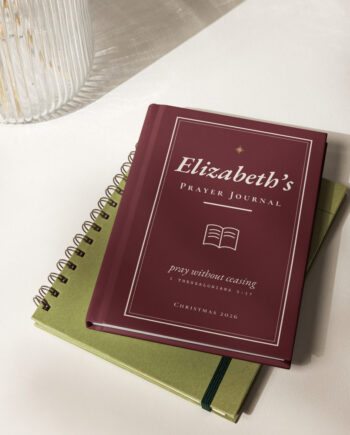
Personalized Prayer Journal | Christian Hardcover Journal with Name, 1 Thessalonians 5:17
$24.00 Select options This product has multiple variants. The options may be chosen on the product page -
✝Psalm 46:5
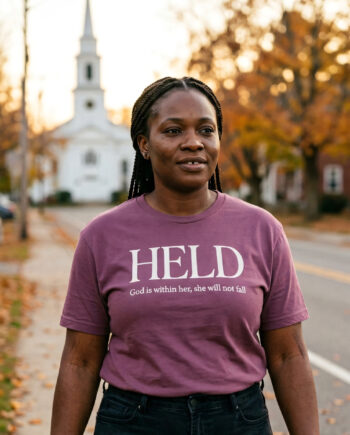
Held | Psalm 46:5 Tee for Women
Price range: $34.00 through $38.00 Select options This product has multiple variants. The options may be chosen on the product page

Keep reading
- Advent 2026 Start Date: Nov 29, Plus a 5-Minute Home RhythmChristian Living
- Christian Thanksgiving Hostess Gifts and Table DecorChristian Living
- Christian Thanksgiving Shirts for the Whole Family TableChristian Living
- Christian Stocking Stuffers for Adults That Get UsedChristian Living
- Psalm 136 Bible Study: Gratitude as RememberingBible Study
More in: Christian Living · All articles