Advent 2026 Start Date: Nov 29, Plus a 5-Minute Home Rhythm
Advent 2026 starts on Sunday, November 29. The four Sundays fall on November 29, December 6, December 13 and December 20, and the season ends on Thursday, December 24, because Christmas Day is a Friday this year.
Advent 2026 starts on Sunday, November 29
Advent begins on the fourth Sunday before Christmas. Since Christmas moves around the week from year to year, the start date moves with it, anywhere from November 27 to December 3. That is why the season can run a little over three weeks in some years and a full four weeks in others. In 2026 it is the shorter kind, with Christmas landing on a Friday and the last Sunday of Advent coming just five days before it.
- First Sunday: November 29
- Second Sunday: December 6
- Third Sunday: December 13
- Fourth Sunday: December 20
- Advent ends: Thursday, December 24
- Christmas Day: Friday, December 25
Free Advent reading · December 1–25
25 Names of Christ
One name a day in your inbox: the verse it comes from, a short reflection, a one-line prayer. It ends on Christmas morning.
One email a day, December 1–25. Unsubscribe anytime.
What Advent is, in plain words
The word comes from the Latin adventus, which means “coming.” The season looks two directions at once. The earlier Sundays lean toward the return of Christ, and the later ones turn back to the birth at Bethlehem.
It is a church-calendar tradition, not a command of Scripture, and it grew over several centuries. In the fourth and fifth centuries, Christians in Spain and Gaul kept a forty-day stretch of prayer and penance before Epiphany. By the sixth century, Roman Christians had tied the season to the second coming, and the link to the first coming came in the Middle Ages. Some Christians keep Advent carefully and some do not observe it at all. Either is a reasonable place to stand, and this guide is for those who want to keep it.
The four weeks: hope, peace, joy and love
The most common modern set of themes is hope, peace, joy and love, in that order. It is common, not universal. Christianity.com also gives an alternate set of hope, faith, joy and peace. Some churches name the candles Prophecy, Bethlehem, Shepherds and Angels. Many churches use three violet or blue candles and one rose candle, many UK Protestant churches use four red ones, and Orthodox families keep a longer fast with its own candle practice. The readings below are conventional, not assigned by the Bible, and lectionaries differ. Pick a scheme and keep it steady for the month.
Week one, November 29: hope
A common anchor is Isaiah 9, where a people in darkness are promised light and a child who will reign. In the King James Version, verse 6 reads: “For unto us a child is born, unto us a son is given: and the government shall be upon his shoulder: and his name shall be called Wonderful, Counsellor, The mighty God, The everlasting Father, The Prince of Peace.” Romans 15:13 makes a good opening prayer for the week. It was not written for Advent, but it names the God of hope, and the KJV says: “Now the God of hope fill you with all joy and peace in believing, that ye may abound in hope, through the power of the Holy Ghost.”
Week two, December 6: peace
Isaiah 40:1–5 is written to exiles. God tells them their hard service is finished, and a voice calls out to prepare the way of the Lord. The KJV opens: “Comfort ye, comfort ye my people, saith your God.” Christians connect this passage to John the Baptist, which is why it often sits in the second week.
Week three, December 13: joy
Luke 2:8–14 is the angel’s announcement to the shepherds. The KJV has: “Fear not: for, behold, I bring you good tidings of great joy, which shall be to all people.” Mary’s song of rejoicing in Luke 1:46–55 is another fitting reading for this week. This is the Sunday when many churches light the rose candle.
Week four, December 20: love
John 3:16 is the usual choice: “For God so loved the world, that he gave his only begotten Son, that whosoever believeth on him should not perish, but have everlasting life” (KJV). It is worth knowing that this verse comes from a conversation with Nicodemus and is not a nativity text. If you want something closer to the manger, 1 John 4:9–10 makes the same point about God’s love shown in sending his Son.
A five-minute rhythm for the household
Many Advent plans ask for something every day from the first of the month, and many families drop them by the second week. This one asks for about five minutes, once, on each of the four Sundays. It has five parts, always in the same order.
- Light one candle, or a single lamp if you have no candle.
- Read the week’s few verses aloud.
- Ask one question and let it sit. Nobody has to answer well.
- Pray one sentence.
- Blow out the candle.
For the first week, read Isaiah 9:2 and 6 and ask, “What are we waiting for this year?” For the second, read Isaiah 40:1–5 and ask what needs comforting in your house right now. For the third, read Luke 2:8–14 and ask where you have heard good news lately. For the fourth, read John 3:16 and ask who needs to be shown love this week, in a way they would notice. A sentence prayer can be as plain as “God, help us to hope,” “give us peace,” and so on down the weeks.
With young children, let one of them strike the match or carry the candle, shorten the reading to a single verse, and let the question be about what they noticed. Alone, the same five minutes works at a kitchen table with a coffee, and the question becomes a line in a notebook. On the fourth Sunday, some households keep a fifth candle in reserve, a white Christ candle, to light on Christmas Eve.
What you need (and what you don’t)
A wreath with four candles is the traditional setup, and the modern wreath is usually credited to Johann Hinrich Wichern, a Lutheran pastor in Hamburg, in 1839. His version had twenty-four small red candles and four large white ones, and later versions shrank it to the four we know. You do not need one. Four tea lights on a plate, or one candle in a jar that you light each Sunday, carries the same meaning. A Bible and a table are the real requirements.
If you would like something to mark the weeks, two things from the shop fit this rhythm. The Advent Ornament Set | Hope, Peace, Joy, Love (2026) carries the four themes of the season in ornament form, and it suits a household that likes to hang or handle something as each Sunday arrives. The Twenty-Five Names of Christ | December Advent Countdown Poster is a wall poster for counting through December, built around names given to Christ, and it suits families who want a small daily glance on top of the weekly candle. Neither is required, and the weekly five minutes works without them.
If you start late or miss a week
Start on any Sunday. If you find this on December 13, light the candle for joy and keep going. If a week is lost to illness or travel, either skip it or fold two themes into one evening, with two readings and one question. The rhythm is small on purpose so that missing a week does not break it. Advent lasts only about a month, and a plan you can keep through all four Sundays will do more than a bigger one you leave after ten days.
Quick answers
When does Advent end in 2026?
On Thursday, December 24. Christmas Day is Friday, December 25.
Why is one candle pink?
In churches that use the violet-and-rose scheme, the rose candle is lit on the third Sunday, called Gaudete Sunday, as a note of joy in the middle of a quieter season. Churches that use four red or four white candles do not have one.
When is the Christ candle lit?
On Christmas Eve or Christmas Day, in households and churches that keep one. It is usually white and sits in the center of the wreath.
Do Protestants observe Advent?
Many do, and many churches across traditions keep it. Others do not, and it is a matter of liberty, not a requirement of Scripture.
Where does the wreath come from?
The modern form is documented from 1839 and Wichern’s work in Hamburg. Some sources trace the basic idea back further, to the sixteenth century.
For a reading that looks both back and forward, as Advent does, see Titus 2:11–13, which speaks of the grace of God that has appeared and of waiting for the blessed hope. It is a good text to keep in mind while the candles burn down.
From the shop
Scripture to wear and give, printed to order.
-
✝Isaiah 40:31

Wings as Eagles | Isaiah 40:31 Tee
Price range: $30.00 through $41.00 Select options This product has multiple variants. The options may be chosen on the product page -
✝Isaiah 9:6
Advent Ornament: Peace | Week Two, Isaiah 9:6 (2026)
$22.00 Add to cart -
✝Isaiah 9:6
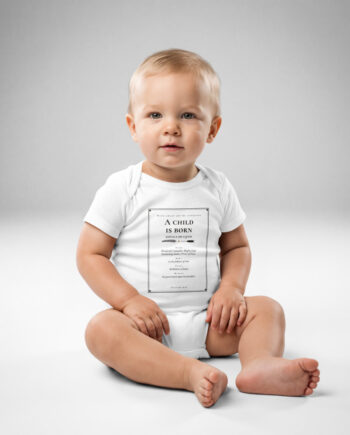
Unto Us a Child Is Born | Isaiah 9:6 Christmas Tee, Crewneck & Bodysuit
Price range: $24.00 through $56.00 Select options This product has multiple variants. The options may be chosen on the product page


Keep reading
- Christian Thanksgiving Hostess Gifts and Table DecorChristian Living
- Christian Thanksgiving Shirts for the Whole Family TableChristian Living
- Christian Stocking Stuffers for Adults That Get UsedChristian Living
- Now Thank We All Our God: The Hymn Story Behind RinkartChristian Living
- The Gospel: God’s Plan of SalvationBible Resources
More in: Christian Living · All articles