Faith Gifts for Someone Going Through a Hard Season

What Not to Give
Before you buy anything, it helps to know what to skip. The gifts that miss are the ones that argue with someone’s pain: a mug printed with “everything happens for a reason,” a plaque that promises the storm passes by spring, a devotional that spends its first week pushing gratitude at someone who hasn’t caught their breath yet. That phrase, “everything happens for a reason,” isn’t in the Bible. It gets handed to hurting people so often that it’s become a way of changing the subject rather than sitting in it.
Skip anything that implies a timeline. “You should be feeling better by now” shows up in gift form more than you’d think: a card built around a set number of healing days, a journal structured in five neat stages toward acceptance. Grief and fear don’t move on a schedule, and a gift that assumes they do tends to land as pressure rather than kindness.
One more trap, easy to fall into with good intentions: gifts that quietly become chores. A plant that needs watering. A craft kit that needs assembling. A book handed over with an unspoken expectation that they’ll report back on what they thought. Someone in a hard season already has enough on the list. Paul told the church at Rome to weep with those who weep, not to hand them something else to manage. The best gifts don’t add to the load. They lighten it, or they simply sit beside it.
Free Advent reading · December 1–25
25 Names of Christ
One name a day in your inbox: the verse it comes from, a short reflection, a one-line prayer. It ends on Christmas morning.
One email a day, December 1–25. Unsubscribe anytime.
When It’s Grief
Start with presence, not products. A meal that shows up without a text asking what they need. Sitting with someone in silence instead of filling the quiet with something to say. That’s the oldest model there is. When Job lost nearly everything he had, three friends came and sat on the ground with him for seven days and said nothing, because his suffering was too large for words. If you can only do one thing, do that. Show up, and let the silence be enough.
If you want to give something in hand, write out a Psalm rather than buying one printed on a mug. Psalm 34:18 is a good place to start:
“The LORD is nigh unto them that are of a broken heart; and saveth such as be of a contrite spirit.”
Psalm 56:8 works too, written by David while he was on the run and afraid, convinced that even his tears mattered:
“Thou tellest my wanderings: put thou my tears into thy bottle: are they not in thy book?”
Neither verse explains the loss or tries to fix it. Both just say the grief is seen, which is worth more than an explanation would be anyway. Leave “she’s in a better place” out of it unless you know exactly what the person believes about that, and hold off on Romans 8:28 as an on-the-spot answer for why this happened. It isn’t a wrong verse. It’s just not a gift in the first weeks.
When It’s a Diagnosis
Fear here has a different shape than grief. The person isn’t looking back at a loss, they’re looking forward into something unknown, often on a schedule of appointments and waiting rooms that isn’t theirs to control. Presence looks practical: going with them to a scan, texting something that needs no reply, taking one logistic off their hands, a ride, a meal train, picking up a prescription so it’s one less errand.
If you give a verse, Isaiah 41:10 speaks to the fear itself rather than to the outcome, which matters, because you don’t know the outcome:
“Fear thou not; for I am with thee: be not dismayed; for I am thy God: I will strengthen thee; yea, I will help thee; yea, I will uphold thee with the right hand of my righteousness.”
Notice what it promises. Not a cure. Presence and strength to get through whatever comes. That’s a truer gift than false reassurance would be.
When It’s a Lost Job
A layoff carries its own quiet shame, even when everyone involved knows it wasn’t the person’s fault. Skip the pity and skip the unsolicited advice about resumes or networking unless they ask. What helps is specific and practical: a meal, covering one bill or one week of groceries, an offer with a real name attached to it rather than “let me know if you need anything.” People in this season rarely ask. Make the offer concrete enough that saying yes doesn’t cost them anything.
When It’s a Long Wait
Some hard seasons don’t have a clear middle or end. Waiting on test results. A job search that stretches past what anyone expected. Infertility. A child who hasn’t come home. These seasons ask more of the people around them, because there’s no single event to rally around, just a long stretch of uncertainty that needs company.
Psalm 130 was written from inside exactly that kind of waiting:
“I wait for the LORD, my soul doth wait, and in his word do I hope. My soul waiteth for the LORD more than they that watch for the morning: I say, more than they that watch for the morning.”
If there’s still strength to reach for, Isaiah 40:31 speaks to renewal in the waiting. Use it gently, and only where it fits. Handed to someone in acute grief it can read as a demand to perform resilience they don’t have yet, but for a long, open-ended wait, it can be honest encouragement rather than pressure.
Showing Up in Month Three
This is the section most gift guides skip, and it might matter more than any single item on this list. In one survey of adults who had lost a parent as children, 57 percent said support from family and friends tapered off within three months of the loss. Twenty percent said it had already faded within the first week, and another 21 percent within the first month. The same survey found it took most respondents over six years to feel able to move forward, and the single most common answer, given by 30 percent, was that they had never felt okay with the loss at all.
That gap, between how fast the casseroles stop and how long the grief actually lasts, is where the most meaningful gift usually lives. A card in month three. A phone call on the anniversary nobody else remembers. A text that just says you’re still thinking of them, sent on an ordinary Tuesday with no occasion attached. Lamentations was written from inside a devastation that hadn’t lifted, and it still says this:
“It is of the LORD’S mercies that we are not consumed, because his compassions fail not. They are new every morning: great is thy faithfulness.”
Faithfulness that renews daily, offered by a person rather than promised in the abstract, is close to the point of this whole list.
A Short List of Physical Gifts
If you want something to put in a box, keep it simple and useful rather than decorative:
- A meal delivery service set up for a few weeks, not just one dinner
- A handwritten note, or a Psalm copied out by hand rather than printed
- A book that sits with lament instead of rushing toward a fix
- A grocery or takeout gift card, which solves a real problem without requiring energy to use
- A candle, simple enough not to clash with whatever else is going on in the house
What a Small Group Can Do Together
Some of the best support isn’t one gift from one person, it’s a small group doing something sustained. Paul told the Galatian church to bear one another’s burdens, and that’s a plural command, written to a community rather than an individual. A meal train that runs for a month rather than a single week does more than any one dish could. So does a shared calendar reminder that surfaces on the hard dates everyone else forgets: the due date that didn’t happen, the anniversary of a diagnosis, the day the job ended.
Paul opens his second letter to the Corinthians by naming God as the source of comfort specifically so that comforted people can go comfort others:
“Blessed be God, even the Father of our Lord Jesus Christ, the Father of mercies, and the God of all comfort; who comforteth us in all our tribulation, that we may be able to comfort them which are in any trouble, by the comfort wherewith we ourselves are comforted of God.”
That’s as good a mission statement for a small group as any. A pooled gift card, a rotating chore list, a standing “who’s checking in this week” rotation. None of it needs to be dramatic. It just needs to keep showing up after the first wave of attention has moved on.
One Thing We’d Point You To
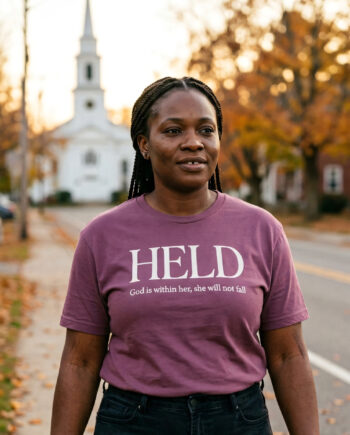
If you’re still looking for something to hand over alongside the meal or the note, we make a couple of shirts built for exactly this kind of season. Held is a quiet one, built around Psalm 46:1, for someone who needs the reminder they’re not carrying this alone. He’s Got It leans a little lighter, a phone-notification design built around Proverbs 3:5, good for someone who could use a small daily nudge toward trust rather than another heavy message. Either one works better as a second gift than a first. Presence still comes before the package.
From the shop
Scripture to wear and give, printed to order.
-
✝Psalm 46:5

Held | Psalm 46:5 Tee for Women
Price range: $34.00 through $38.00 Select options This product has multiple variants. The options may be chosen on the product page -
✝Psalm 46:10
Coffee and Quiet Time Retro Hoodie | Psalm 46:10
Price range: $49.00 through $51.00 Select options This product has multiple variants. The options may be chosen on the product page -
✝Psalm 95:6
O Come Let Us Adore Him | Psalm 95:6 Christmas Crewneck & Tee
Price range: $34.00 through $56.00 Select options This product has multiple variants. The options may be chosen on the product page


Keep reading
- Advent 2026 Start Date: Nov 29, Plus a 5-Minute Home RhythmChristian Living
- Christian Thanksgiving Hostess Gifts and Table DecorChristian Living
- Christian Thanksgiving Shirts for the Whole Family TableChristian Living
- Christian Stocking Stuffers for Adults That Get UsedChristian Living
- You Don’t Have to Explain Yourself FirstDevotional
- In Due Season: Galatians 6:9 for Anyone Tired of Doing GoodDevotional
More in: Christian Living · All articles