The Scene at Shinar
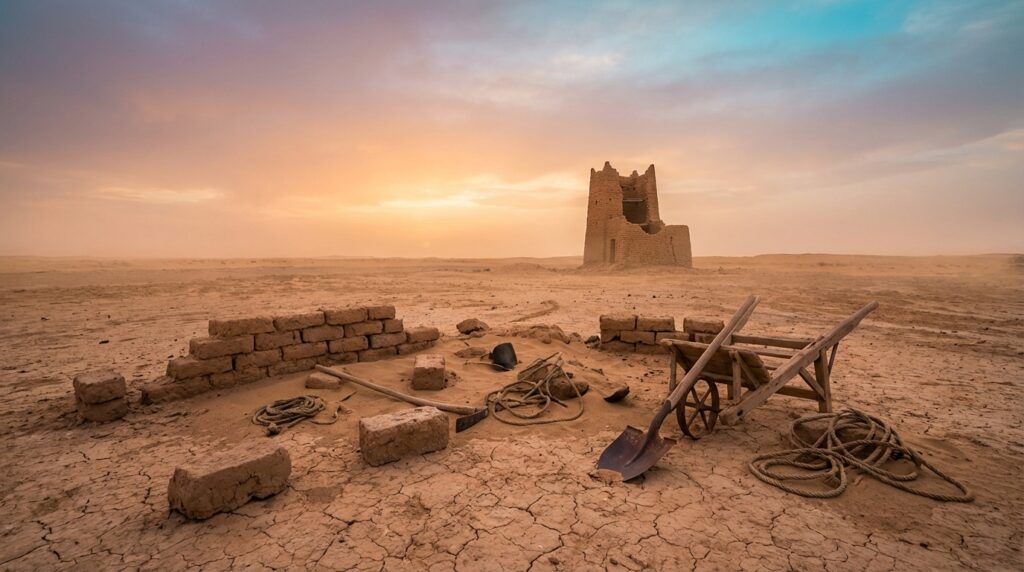
What humanity’s first skyscraper reveals about our deepest hunger
The Scene at Shinar
Genesis 11 opens in a world still echoing with God’s command to Noah’s descendants: “Be fruitful and multiply and fill the earth.” But humanity had other plans. They gathered in the plain of Shinar — the land that would become Babylon — and decided to stay put. United by a single language and a singular ambition, they launched the world’s first architectural wonder project.
The people weren’t building a stairway to heaven out of devotion. This was a monument to human achievement, a declaration of independence from God’s design. They wanted fame, permanence, unity on their own terms. The tower would be their legacy, their security, their identity. But notice what happens next — God comes down to see what they’re building. The irony is piercing: their tower reaching toward heaven is so small that God has to descend just to get a good look at it.
Free Advent reading · December 1–25
25 Names of Christ
One name a day in your inbox: the verse it comes from, a short reflection, a one-line prayer. It ends on Christmas morning.
One email a day, December 1–25. Unsubscribe anytime.
The Deeper Meaning Behind the Bricks
The Hebrew text reveals layers of meaning we miss in translation. When the people say “let us make a name for ourselves,” they’re using language that echoes God’s promise to Abraham just chapters later — that God would make Abraham’s name great. They’re trying to seize by human effort what only God can give as a gift. They want to create their own significance rather than receive it from their Creator.
The phrase “tower that reaches to the heavens” uses the Hebrew shamayim, which can mean both the sky and the spiritual realm. Ancient ziggurats in Mesopotamia were designed as meeting places between gods and humans — literally called “houses of the foundation of heaven and earth.” But the people of Babel weren’t building a place to meet God; they were building a monument to replace Him.
God’s response is both judgment and mercy. He confuses their language and scatters them across the earth — which sounds harsh until you realize He’s actually fulfilling His original purpose for them. They were supposed to fill the earth. Their unity had become toxic, a collective rebellion that would only calcify if left unchecked. God breaks their project not to destroy them, but to redirect them toward their true calling.
Notice God says “nothing they plan to do will be impossible for them” — not as a compliment, but as a warning. United human pride, unchecked by humility before God, leads to unlimited capacity for self-destruction. Think of every totalitarian regime in history, every ideology that promised heaven on earth through human power alone. Babel is the first, but not the last, time humanity mistakes unity for righteousness and ambition for worship.
Our Modern Towers
We don’t build ziggurats anymore, but the impulse remains unchanged. We construct towers of success, influence, self-sufficiency. We curate online personas that reach toward some imagined heaven of validation. We hustle and grind, believing that if we just build high enough, fast enough, impressively enough, we’ll finally make a name for ourselves. We’ll finally matter.
But here’s what Babel teaches us: the name we’re trying to make for ourselves is already given. We don’t have to build our way to significance because God has already spoken our identity into existence. We are image-bearers, beloved children, known completely and loved anyway. The tower we’re exhausting ourselves to construct is unnecessary. God doesn’t need to come down to see us — He’s already here, closer than our own breath.
The people at Babel feared being scattered, losing their collective identity, fading into obscurity. But God’s plan was never to erase them — it was to spread them, to multiply their influence, to fill the earth with His image. What they saw as loss was actually multiplication. What felt like judgment was redirection toward purpose. Sometimes God breaks what we’re building not because He’s against us, but because He’s for something better in us.
What Babel Reveals
Our deepest desire isn’t actually for fame or achievement — it’s to be known and to matter. We build towers because we’re terrified of being forgotten. But God sees, God knows, God remembers. The question isn’t whether we’ll make a name for ourselves, but whether we’ll trust the name God has already given us.
What Pentecost Reverses
In Acts 2, the Holy Spirit comes at Pentecost and people from every nation hear the gospel in their own language. What was confused at Babel is redeemed at Pentecost. God doesn’t erase diversity — He sanctifies it. Unity in Christ doesn’t mean uniformity; it means every tribe and tongue worshiping the same God in their own voice.
Living Beyond the Tower
So what does it look like to stop building towers? It starts with recognizing when we’re constructing monuments to ourselves rather than living as temples of the Holy Spirit. It means asking: Am I hustling for significance or resting in the significance already given? Am I building my kingdom or seeking God’s? Am I afraid of being scattered — of losing control, status, or certainty — when God might be calling me to go, to release, to trust?
The people of Babel wanted to stay together on their own terms. God scattered them for their good and the good of the world. Sometimes the greatest act of faith is to let God dismantle what we’ve built and trust Him to lead us somewhere better. Not as a punishment, but as an invitation into His larger story.
Jesus doesn’t call us to build higher — He invites us to come lower, to rest, to stop striving. The tower-building life is exhausting. The life rooted in God’s presence is abundant. We don’t need to make a name for ourselves. We need only to trust the One who knows our name, who numbered every hair on our heads, who holds our days in His hand. That’s not passivity — it’s the deepest form of courage. To stop building and start trusting. To stop performing and start belonging.
The tower at Babel was never finished. It stands in Scripture as an eternal reminder that human ambition apart from God leads nowhere but confusion. But God’s plan? That cannot be stopped. His purposes will be fulfilled. His kingdom will come. And His people — scattered, diverse, speaking a thousand languages — will one day be gathered around His throne, not because we built our way there, but because He built a bridge to us in Jesus Christ.
Rooted in Truth, Not Towers
At JT4Christ, we’re passionate about helping believers ground their identity not in what they build, but in who God says they are. Explore our faith-inspired apparel and resources designed to remind you daily of God’s truth.
Shop NowFrom the shop
Scripture to wear and give, printed to order.
-
✝Genesis 1:1

Elohim | Genesis 1:1 Tee
Price range: $34.00 through $40.00 Select options This product has multiple variants. The options may be chosen on the product page -
✝Genesis 8:22
Seedtime and Harvest Shall Not Cease | Genesis 8:22 Tee & Sweatshirt
Price range: $34.00 through $72.00 Select options This product has multiple variants. The options may be chosen on the product page -
✝Genesis 8:22
Seedtime and Harvest Shall Not Cease | Genesis 8:22 Print
Price range: $29.00 through $99.00 Select options This product has multiple variants. The options may be chosen on the product page

Keep reading
- Youth Group Shirt Ideas: Christian Tees Teens Will Actually WearChristian Living
- Christian Gifts for Dad: 8 Faith-Based Gifts He Will UseChristian Living
- Who You Are in Christ: Your Identity, and the Shirts That Say It Out LoudChristian Living
- Bible Verse T-Shirts: How to Wear Scripture That Actually Means SomethingBible Study
- What the Persistent Widow Teaches Us About Praying When God Seems SilentBible Study
- The Historical Moment: Israel in CrisisFaith & Encouragement
More in: Faith & Encouragement · All articles